
American Wire Gage (AWG)
Definition: A standard system used in the United States for designating the size of an electrical conductor based on a geometric progression between two conductor sizes.
Related Links
American wire gauge – WikipediaAmerican Wire Gauge (AWG) Cable Conductor Size Chart / Table
What is American Wire Gauge (AWG)? – Definition from WhatIs.com
What is American Wire Gage (AWG), and Why Does it Matter?
Related Videos
American Wire Gauge (AWG) Standards - A GalcoTV Tech Tip
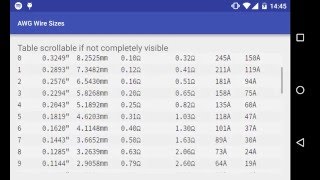
AWG Wire Sizes
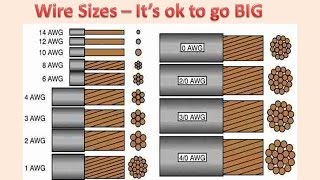
What Size Wire Do I Use To Wire My Solar Components? Does Wire Size Matter?
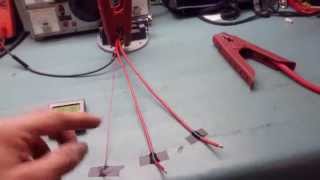
Test of 10, 12 and 24 gauge wires at 100A !!
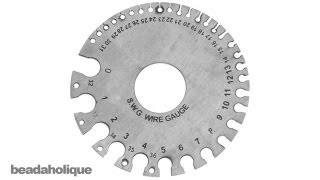
How to Use a Wire Gauge Tool
What I had to teach myself: types and sizes of electrical cable
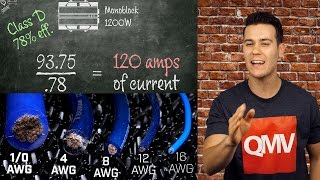
Power, Ground and Speaker Wires - What Wire Gauge Should You Use?

My View On Cheap Chinese / Imported 4 Gauge AWG Wire Opposed To Made In The USA
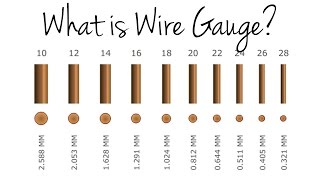
What is Wire Gauge?

How To Chose The Best Speaker Wires: Best Gauge, Brand ...

Wire size vs. amperage

WHAT GAUGE (AWG) WIRE TO USE FOR A MULTIROTOR?

Car Audio Speaker Wire: Big VS Small - 8 Gauge To 10 AWG w/ ACT's SPL Stereo Termlab Bass Comparison

How to Convert AWG - American Wire Gauge to Diameter and Metric
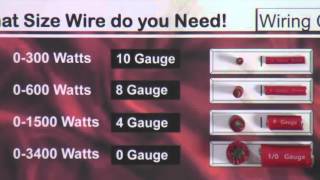
Install Tips: What Size Power Wire Do I Need?

Determining the AWG
-
American Wire Gauge (AWG) Standards - A GalcoTV Tech Tip
-
AWG Wire Sizes
-
What Size Wire Do I Use To Wire My Solar Components? Does Wire Size Matter?
-
Test of 10, 12 and 24 gauge wires at 100A !!
-
How to Use a Wire Gauge Tool
-
What I had to teach myself: types and sizes of electrical cable
-
Power, Ground and Speaker Wires - What Wire Gauge Should You Use?
-
My View On Cheap Chinese / Imported 4 Gauge AWG Wire Opposed To Made In The USA
-
What is Wire Gauge?
-
How To Chose The Best Speaker Wires: Best Gauge, Brand ...
-
Wire size vs. amperage
-
WHAT GAUGE (AWG) WIRE TO USE FOR A MULTIROTOR?
-
Car Audio Speaker Wire: Big VS Small - 8 Gauge To 10 AWG w/ ACT's SPL Stereo Termlab Bass Comparison
-
How to Convert AWG - American Wire Gauge to Diameter and Metric
-
Install Tips: What Size Power Wire Do I Need?
-
Determining the AWG
What American wire gauge (AWG) means and why electricians use it
American wire gauge, or AWG, is the standard system used in the United States to measure the diameter of electrical wire. The system assigns a number to each wire size. A lower number means a thicker wire. A higher number means a thinner wire. This feels backwards at first, but it makes sense once you understand how the system was built.
If you are considering a career in the electrical trades, you will use AWG every single working day. Knowing how to read a wire gauge chart is one of the first practical skills you pick up in any electrician training program.
How the AWG numbering system works
The AWG scale runs from 0000 (written as 4/0 and pronounced “four-ought”) down to very thin gauges like 40 AWG. For most residential and commercial electrical work, you will work with wires between 14 AWG and 4/0 AWG.
Each step up in gauge number reduces the wire’s cross-sectional area by a fixed ratio. This consistent math is what makes AWG reliable and predictable across the industry.
Here is a quick reference for the most common sizes you will see on job sites:
- 14 AWG is used for 15-amp circuits, such as standard lighting and outlet circuits in homes.
- 12 AWG is used for 20-amp circuits, including kitchen outlets and bathroom receptacles.
- 10 AWG handles 30-amp circuits, often used for dryers and air conditioners.
- 8 AWG handles 40-amp to 50-amp circuits, common for electric ranges.
- 6 AWG is typical for 55-amp to 60-amp loads.
- 4/0 AWG is used for large service entrance conductors and feeders.
Wire gauge, ampacity, and why the two are always connected
Ampacity is the maximum amount of electrical current a wire can carry safely without overheating. Every AWG size has a rated ampacity. Choosing the wrong gauge for a circuit is a code violation and a fire hazard.
The National Electrical Code (NEC), published by the National Fire Protection Association, sets the ampacity tables that electricians follow. Your state may adopt the NEC with local amendments, so always check your jurisdiction’s adopted code version.
How temperature rating affects the ampacity of a wire
A wire’s insulation has a temperature rating, typically 60 degrees Celsius, 75 degrees Celsius, or 90 degrees Celsius. A higher temperature rating allows a higher ampacity for the same AWG size. For example, a 12 AWG copper conductor with 75-degree-rated insulation (type THWN) has a higher ampacity than the same wire with 60-degree insulation (type TW).
In practice, most terminations at breakers and devices are rated for only 75 degrees Celsius, even if the wire insulation is rated higher. You must always derate to the lowest-rated component in the circuit.
Copper vs. aluminum wire and how AWG applies to both
AWG applies to both copper and aluminum conductors, but aluminum carries less current than copper at the same gauge. To carry the same ampacity, aluminum wire must be one or two sizes larger than copper wire. For example, 2 AWG aluminum roughly matches the ampacity of 4 AWG copper in many applications.
Aluminum wiring is common for service entrance conductors and large feeder runs because aluminum costs less than copper for large sizes. However, aluminum requires anti-oxidant compound at connections and specific rated devices to prevent connection failures.
Reading a wire gauge chart on the job
A wire gauge chart lists AWG sizes alongside diameter in inches, diameter in millimeters, resistance per 1,000 feet, and ampacity under various conditions. You will use these charts when sizing conductors, calculating voltage drop over long runs, and verifying compliance with the NEC.
Voltage drop and wire sizing over long distances
When current travels through a long run of wire, some voltage is lost due to the resistance of the conductor. This is called voltage drop. The NEC recommends keeping voltage drop below 3 percent for branch circuits and below 5 percent total for feeders and branch circuits combined.
To limit voltage drop over a long run, you upsize the wire. For example, a circuit that would normally use 12 AWG copper for a 20-amp load at 50 feet might need 10 AWG copper if the run is 150 feet. Knowing how to calculate this is a core skill taught in apprenticeship programs and electrician trade schools.
Solid wire vs. stranded wire at the same AWG
AWG applies to both solid and stranded wire. Solid wire has one single conductor. Stranded wire has multiple thin wires twisted together. The overall AWG rating describes the equivalent cross-sectional area, not the individual strands.
Stranded wire is more flexible and better suited for conduit pulls and applications where the wire will move. Solid wire is common in residential branch circuit wiring run inside walls. Both types follow the same AWG ampacity tables.
AWG in the context of the NEC and electrical code compliance
Every state in the US uses the NEC as the foundation for its electrical code. Some states are on a more recent edition than others. As of 2026, many jurisdictions are adopting the 2023 NEC. Your state’s electrical licensing board will specify which edition applies in your area.
AWG wire sizing requirements appear throughout the NEC. Article 310 covers conductors for general wiring and contains the core ampacity tables. Article 240 covers overcurrent protection and tells you how to match breaker size to wire gauge. Article 220 covers branch circuit and feeder calculations.
Why wire sizing violations are a top inspection failure
Incorrect wire gauge is one of the most common reasons electrical inspections fail. An undersized wire can overheat, melt its insulation, and start a fire. An oversized breaker protecting an undersized wire defeats the purpose of the overcurrent protection device entirely. Inspectors check wire size against breaker rating on every inspection.
Learning to size conductors correctly before you ever step on a job site is why electrical training programs spend significant time on AWG and the NEC ampacity tables.
AWG knowledge in electrician training programs
If you want to work as an electrician, understanding AWG is not optional. It is tested on licensing exams in every state. Apprenticeship programs run by the International Brotherhood of Electrical Workers (IBEW) and the National Electrical Contractors Association (NECA) teach conductor sizing in the first year of training. Trade school programs cover it in the first semester.
How wire gauge appears on electrician licensing exams
Most journeyman and master electrician licensing exams are open-book exams based on the NEC. Questions about wire sizing, ampacity, and voltage drop appear on every version of these exams. You bring the NEC to the test, but you need to know where to find the tables and how to apply them quickly. Practice with real NEC problems is the best preparation.
What to expect in a training program covering AWG
A good electrician training program will teach you to:
- Read NEC ampacity tables and apply correction factors for temperature and conduit fill.
- Calculate voltage drop for branch circuits and feeder runs.
- Select the correct wire type (THHN, THWN, USE, etc.) for each application.
- Identify wire gauge by sight and with a wire gauge tool.
- Match wire size to circuit breaker size and load requirements.
Programs at community colleges, trade schools, and apprenticeship training centers all cover these topics. Program length varies. Certificate programs can take as little as one year. Associate degree programs typically take two years. Apprenticeships run four to five years and combine paid on-the-job training with classroom instruction.
Tools used to identify wire gauge in the field
You cannot always read the printing on a wire insulation jacket, especially on older wiring or wires pulled through conduit. Electricians use a wire gauge tool, a small flat plate with labeled slots, to measure conductor diameter and identify AWG size by fitting the bare conductor into the corresponding slot.
Digital calipers also work for measuring wire diameter. Once you have the diameter in inches or millimeters, you can match it to an AWG chart. This skill matters in service work and renovation jobs where you are working with existing wiring that may not be labeled.
Common mistakes students make with AWG
The most common mistake is confusing higher numbers with larger wire. Remembering that 14 AWG is thinner than 10 AWG takes repetition. The second common mistake is forgetting to apply derating factors. When you run multiple current-carrying conductors in the same conduit, the NEC requires you to reduce the ampacity of each conductor. Skipping this step leads to code violations.
A third mistake is using the wrong ampacity column. The NEC ampacity tables have separate columns for 60-degree, 75-degree, and 90-degree-rated conductors. Using the 90-degree column when your terminations are only rated for 75 degrees gives you an incorrect and unsafe result.
Training programs that include hands-on lab work help you avoid these mistakes by giving you practice under supervision before you are responsible for real installations.
Next steps if you want to build on this knowledge
Understanding AWG is a starting point. The full skill set of a licensed electrician includes load calculations, blueprint reading, conduit bending, motor control, and code compliance across all NEC chapters. These skills come from structured training and hands-on practice.
If you are ready to take the next step, look into electrician training programs in your area. Community college programs, trade schools, and apprenticeship applications are all worth exploring. A program that teaches NEC application alongside hands-on lab work gives you the best preparation for the licensing exam and for real job sites.
Browse electrician training programs to find one that fits your schedule and career goals.


